8 Steps to Find Phlebotomy Classes for Working Adults

Last Updated: November 4, 2026
Quick Summary
To find phlebotomy classes for working adults, start by mapping your available hours, travel range, and time off before browsing schools. Then look for hybrid evening, weekend, or part-time rolling programs, and confirm lab and clinical hours in writing. Verify accreditation, clinical hours, and exam eligibility before you pay.
Online coursework is flexible, but every legitimate program requires in-person lab sessions and a clinical externship.
Hybrid evening cohorts typically meet one or two evenings per week, often from 5 to 9 p.m.
A 12-week program spreads training hours over a lighter pace that suits full-time workers.
Ask your employer about tuition assistance, workforce funds, and exam fee sponsorship before comparing payment plans.
Ask admissions for a sample weekly schedule from the most recent cohort to confirm flexible options are real.
Table of Contents
Phlebotomy Classes for Working Adults Online: What You Can and Cannot Do Remotely
Evening Phlebotomy Classes and Weekend Options Worth Asking About
Phlebotomy Program Length: What 4, 8, and 12 Weeks Actually Mean for Your Week
Phlebotomy Classes With Financial Aid: Employer Tuition Help and Assistance Programs
Verify the Program Before You Pay: Accreditation, Clinical Hours, and Exam Eligibility
Balance Class, Clinicals, and a Full-Time Job Without Burning Out
Start With Your Schedule, Not the School List
Most working adults start their search the wrong way. They open a browser, type "phlebotomy classes near me," and collect a list of schools.
Flip the order. Before you look at a single program, map the hours you can actually give to school each week.
Before you look at any program, write down three things first:
The days and times you are free, including weekends
How far you can travel for hands-on labs
How much time off work you can take, if any
That short list filters out half the programs you would otherwise waste time on. Finding phlebotomy classes for working adults starts with your calendar, not a campus tour.
Phlebotomy Classes for Working Adults Online: What You Can and Cannot Do Remotely
Online phlebotomy classes for working adults online cover the book work well. You can finish lectures, quizzes, and exam prep from your couch after a shift. That part is genuinely flexible.
Blood drawing is a hands-on skill, though. You cannot learn venipuncture by watching a video. Programs know this, so they build in a lab requirement.
The Hands-On Requirements Online Programs Still Require
Every legitimate program pairs online coursework with in-person practice. Expect to attend:
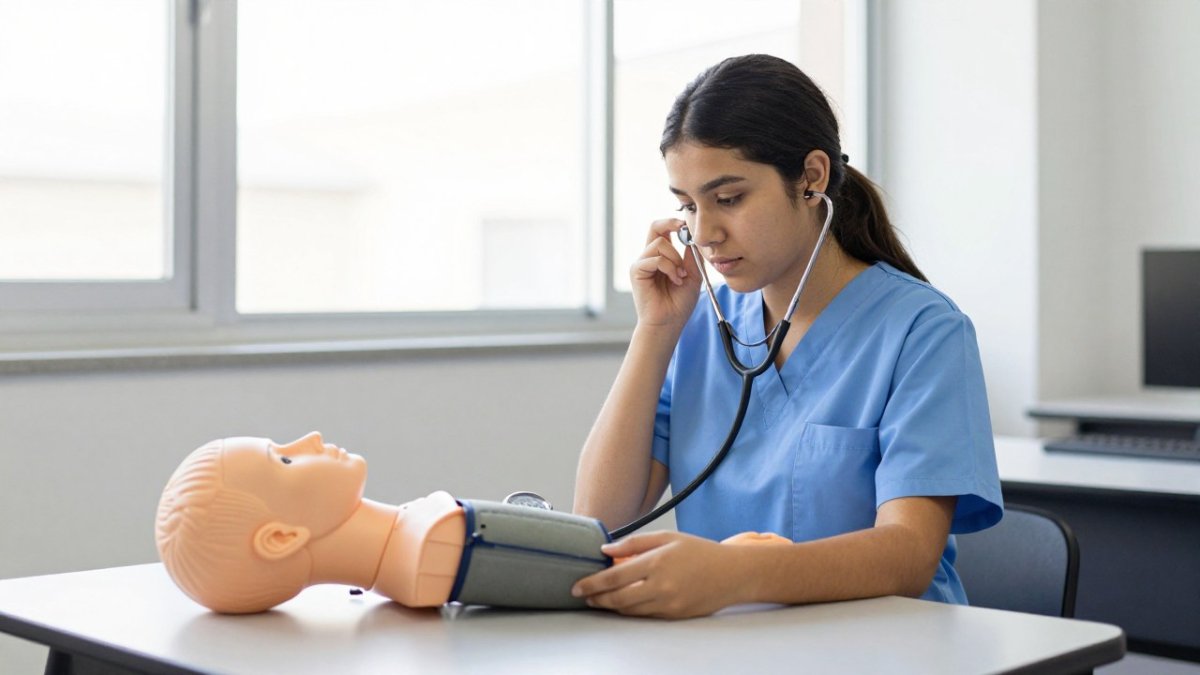
Supervised lab sessions to practice blood collection on training arms
A simulation kit for home practice between labs
A clinical externship where you draw blood on real patients under supervision
Ask how many in-person hours the program requires before you enroll. A program that promises "100% online" phlebotomy training is not preparing you for a real job. Our own in-person phlebotomy lab shows how the hands-on piece fits into a real program.
Evening Phlebotomy Classes and Weekend Options Worth Asking About
Evening and weekend phlebotomy classes exist, but they are rarely advertised on the program's main page. Many schools run daytime cohorts as their default and add evening or weekend sections only when enough students request them.

The Three Schedule Models You Will Encounter
Most flexible phlebotomy programs fall into one of three formats. Knowing which one you are looking at tells you how much of your week gets committed.
Hybrid evening cohort. Lectures and quizzes are online and self-paced; labs meet one or two evenings per week, often 5 to 9 p.m. This is the most common format for working adults because it protects daytime shifts.
Weekend intensive. Labs meet on Saturdays, sometimes both Saturday and Sunday, for a compressed block. This suits people with weekday-only jobs but can be heavy on clinical hours in a short window.
Part-time rolling enrollment. Students start on different dates and attend labs on a fixed weekly slot until they finish the required hours. This is the most forgiving for shift workers, but it can stretch total completion time.
A program that offers only a daytime cohort is not necessarily closed to you, ask whether it will add an evening section if enough applicants request one. A common pattern is that schools hold a waitlist and open a night cohort once it fills.
What to Confirm Before You Count on a Night or Weekend Slot
A verbal "yes, we have evening classes" is not enough. Ask for the specific details that determine whether the schedule actually fits your life:
Exact meeting days and times, including start and end times, not just "evenings."
Number of in-person lab hours per week and whether any labs fall on a different day than lectures.
Clinical scheduling. This is the piece working adults most often overlook. Externships are usually arranged with a partner clinic or hospital, and those sites set their own hours, often weekday daytime only. Ask who places the externship and whether evening or weekend clinical slots are available.
Watch out: a program can advertise evening classes while scheduling the clinical externship on weekday mornings. Confirm the externship hours separately before you enroll.
How to Verify the Schedule Is Real
Ask to see a sample weekly schedule from the most recent cohort, not a marketing flyer. A legitimate program can produce a calendar showing lab dates, clinical dates, and exam dates.
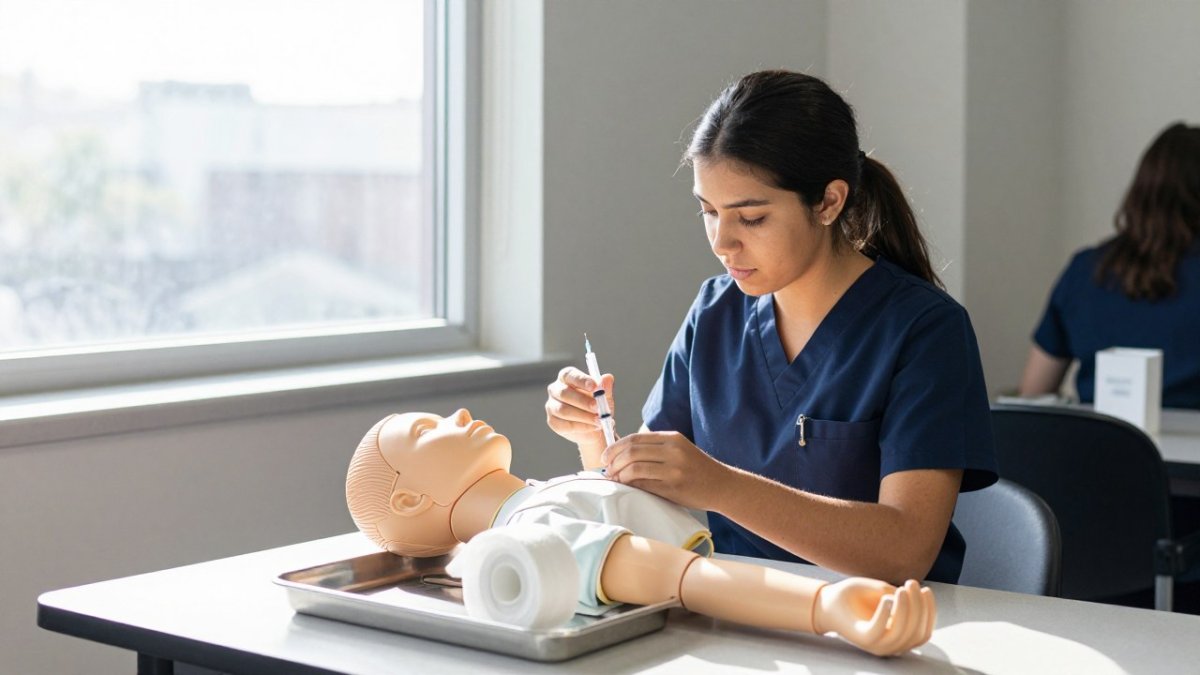
If you need a night option, our evening phlebotomy sessions show what that looks like in practice, including how lab and clinical hours are sequenced around a full-time work week.
Phlebotomy Program Length: What 4, 8, and 12 Weeks Actually Mean for Your Week
Program length tells you how much of your week gets committed, not just how many weeks you sit in class.
Program Length | Weekly Time Commitment | Best For |
4 weeks | Heavy, near full-time | Students between jobs |
8 weeks | Moderate, part-time friendly | Most working adults |
12 weeks | Lighter, steady pace | Full-time workers with tight schedules |
A 12-week program spreads the load, which suits people juggling a job. An 8-week track is the common middle ground.
Ask each school for the total training hours and clinical hours, then divide by the number of weeks. That number tells you what your week will really look like.
Phlebotomy Classes With Financial Aid: Employer Tuition Help and Assistance Programs
Phlebotomy training is generally shorter and less expensive than degree programs, so many working adults look for ways to fund it before borrowing, if they work the options in the right order. The mistake is starting with the school's payment plan before checking whether someone else will pay.
Step 1: Ask Your Employer First
Hospitals, clinics, labs, and long-term care employers frequently pay for phlebotomy training because they need technicians and it is cheaper to train a current employee than to recruit a new one. Ask your HR department specifically about:
Tuition assistance or reimbursement. Confirm the maximum amount per year, whether it is paid upfront or reimbursed after completion, and whether you must remain employed for a set period afterward.
Workforce development funds. Larger health systems sometimes hold dedicated training budgets for roles with shortages; phlebotomy is often on that list.
Exam fee sponsorship. Some employers cover the national certification exam fee separately from tuition.
Get any employer commitment in writing before you enroll, including the repayment terms if you leave early.
Step 2: Check Workforce and Grant Funding
State and local workforce boards administer short-term training grants for in-demand healthcare roles. The application process varies, but the common pattern is that you apply through the workforce board, get approved for a specific program, and the funds go directly to the school.
For federal programs, the federal student aid site explains grants and loan options, though phlebotomy certificate programs are often too short to qualify for federal aid on their own.
Step 3: Compare School Payment Options on Total Cost
Only after employer and grant options are exhausted should you compare the school's own payment terms. Ask each program:
Is tuition all-inclusive, or are textbooks, lab supplies, CPR certification, uniforms, background checks, and exam fees billed separately?
Is there an internal payment plan, and does it carry interest or a fee?
Is any portion refundable if you withdraw, and on what schedule?
Ask whether tuition is all-inclusive; some programs cover textbooks, lab supplies, and CPR certification, which removes surprise costs later. A lower headline tuition with add-on fees can end up costing more.
Watch out: a payment plan that spreads tuition over the program can make a program look affordable while hiding that the exam fee and supplies are not included. Ask for the total out-of-pocket figure, not the monthly payment.
Step 4: Reduce the Costs Aid Does Not Cover
The remaining costs are usually travel, childcare, and lost wages during clinical hours. Plan for them:
Choose a program with a clinical site close to home or work to cut commute time.
Schedule clinical days on your regular days off where the program allows it.
Ask whether the program offers any scholarship or discount for employees of partner healthcare organizations.
Our medical assistant certification cost breakdown shows how to read a program's full price line by line, and the same method applies to phlebotomy tuition.
Verify the Program Before You Pay: Accreditation, Clinical Hours, and Exam Eligibility
The program you pick must make you eligible to sit for a national certification exam. If it does not, your certificate is worth little to employers.
Check three things before you pay:
Accreditation. Confirm the program is recognized by a body employers trust.
Clinical hours. Ask exactly how many hands-on clinical hours you complete and where.
Exam eligibility. Confirm graduates can register for a certified phlebotomy technician exam.
Questions to Ask Admissions Before Enrolling
Bring this list to every call:
Is the program accredited, and by whom?
How many clinical hours do students complete?
Can graduates sit for a national certification exam?
A school that answers all seven without hesitation is worth your time.
Compare Total Cost, Not Just Tuition
Tuition is the headline number. The real cost includes everything else. Add up textbooks, lab supplies, exam fees, CPR certification, uniforms, background checks, and travel to labs.
A cheaper program with add-on fees can cost more than an all-inclusive one. Ask for a written breakdown of every cost before you commit.
Watch out: a low tuition figure that excludes exam fees and supplies often ends up the most expensive option once everything is added.
Balance Class, Clinicals, and a Full-Time Job Without Burning Out
Fitting training around a full-time job is the hardest part, and it is where most adults quit. The fix is planning, not willpower.
Try these habits:
Block study time on your calendar like a shift
Do online coursework in short daily sessions, not marathon weekends
Save your heaviest clinical days for your days off
For deeper strategies, see our guide on managing clinical lab hours with a busy family schedule and how to balance full-time work with CNA training.
Finding phlebotomy classes for working adults comes down to matching a program to your real schedule, checking its hands-on requirements, and confirming total cost and exam eligibility before you pay.
Frequently Asked Questions
Can you take phlebotomy classes while working full time?
Yes. Many phlebotomy programs are built for working adults, with evening classes, weekend labs, and hybrid formats that combine online coursework with scheduled in-person sessions. The practical limit is the hands-on portion: you still need to attend labs and a clinical externship, which often run 40 hours or more. Before enrolling, map your work schedule against every required lab date and clinical shift, not just the classroom hours, so you know exactly which weeks will be tight.
How long does phlebotomy program length typically run?
Phlebotomy program length varies by format. Some accelerated programs run about 4 to 8 weeks, standard community college tracks often take a semester, and programs that bundle a clinical externship can run 12 weeks or longer. Shorter does not automatically mean easier: a 4-week program usually means more hours per week. Ask each school for total training hours, including classroom, lab, and clinical time, so you can compare programs on the same basis.
Are there evening or weekend phlebotomy classes for working adults?
Many schools offer evening phlebotomy classes and weekend lab sessions, but availability depends on the program and cohort size. Ask specifically whether the hands-on labs, not just lectures, are offered outside standard business hours, since labs are the part that usually conflicts with a job. Also confirm how often you must be on campus. A hybrid program that meets one evening per week is workable for most full-time employees; one that requires three weekday visits is not.
How can I find phlebotomy classes with financial aid?
Start with three sources: employer tuition assistance, workforce development grants through your state or local workforce board, and school payment plans. Ask your employer's HR department whether tuition reimbursement covers short certificate programs, since many policies do. Then ask each school what financial assistance it accepts and whether aid can be applied to lab fees and textbooks, not just tuition. Get the total cost in writing before you commit so you can compare aid offers accurately.

Comments